Internet providers make certain types of connections available to their subscribers; Of course, Internet connection in Iran is currently widely done through ADSL. However, according to the announcement of Mohammad Javad Azari Jahormi, the Minister of Communications and Information Technology, ADSL Internet is going to be upgraded to VDSL. Jahormi says that thanks to VDSL, the speed of the home internet will be at least four times.
Digital Subscriber Line or DSL is a special technology that provides broadband internet to the user using home phone lines. Large companies in different countries make home internet available to users by relying on DSL technology; Three types of connections including ADSL (Asymmetric Digital Subscriber Line), VDSL (Very High Bit Rate Digital Subscriber Line) and UFB (Optical Fiber) are among the most popular around the world today and offer various advantages to users. These are not the only types of DSL; In fact, the technologies developed on the DSL platform include other things such as HDSL, SDLS, etc.
However, understanding the main difference between ADSL, VDSL and fiber optic will allow you to choose the best possible option considering your circumstances and needs when all three of them become widely available nationwide.
ADSL Internet
ADSL stands for Asymmetric Digital Subscriber Line. ADSL is actually a special type of DSL technology that allows you to use broadband internet by using the usual copper wires of telephone lines. The transmission of the Internet network through copper wires takes place without interrupting voice calls and does not cause any problems for it.
The advantage of using ADSL technology to connect to the Internet is that you don’t need any special wires to use it, and you can use the same wiring as your home phone. Referring to this issue, we realize that setting up and using ADSL internet costs less for the user; In addition, this type of connection is more widely available to users compared to VDSL and optical fiber, because, as we said, it does not require special equipment.
By using ADSL, you can download your desired content from the Internet at a maximum speed of 24 Mbps; But in this technology, the upload speed is much more limited. Needless to say, the final speed of your download and upload, regardless of the service you purchase from different companies, is also related to the quality of the wire. If the phone wire you are using is old and of poor quality, you will get slower speeds than you think. Among other things that have a significant effect on ADSL download and upload speed, we can mention your distance from the telecommunication center and the presence of noise on the line.
As we mentioned, ADSL means asymmetric digital subscription line, but what does the term “asymmetric” in the name of this technology mean? In ADSL services, download and upload speeds are very different from each other; In fact, the download speed is much higher than the upload speed. Therefore, this type of technology is called asymmetric digital subscription line. Another technology has been developed on the basis of ADSL, which is called ADSL2+ and is widely used in Iran today. ADSL2+ as a new generation of ADSL technology is for those users who live at a maximum distance of 2 kilometers from the telecommunication center.
VDSL Internet
Another technology developed on the basis of DSL and these days you may have heard its name many times in different places is called VDSL. VDSL stands for Very-high-bitrate Digital Subscriber Line and is more similar to Cable Internet than ADSL. In fact, although VDSL is also developed based on DSL, there are similarities between this technology and cable internet.
VDSL internet speed
According to experts, VDSL can provide up to three times higher download speed compared to ADSL. Another important point about this technology is the upload speed. The upload speed of VDSL internet is 10 times higher than ADSL.
The first generation of VDSL services are based on copper wires with the ability to transmit frequencies of 25 kHz to 12 MHz. This signal shows that the first generation of VDSL can provide a download speed of 52 Mbps and an upload speed of 16 Mbps. VDSL services have the potential to provide upload speeds of around 60 Mbps to the user; Of course, getting this high speed depends on various criteria. If you have a short distance from the telecommunication center, you will be able to reach this high speed. Needless to say, in the second generation of VDSL, i.e. VDSL2, copper wires with the ability to transmit a frequency of 30 MHz are used; Thanks to this type of wire, VDSL2 services offer a staggering download and upload speed of 100 Mbps.
Fiber optic internet
UFB stands for Ultra-Fast Broadband and is usually referred to as fiber internet. UFB Internet has been specially developed in many countries in recent years and has been able to attract a lot of attention. Fiber Internet launched with the promise of 1 Gbps download and upload speeds, but statistics show that this type of internet typically achieves 300 Mbps download and upload speeds. Fiber Internet still has a lot of potential for improvement, and many high-end households and businesses that need very high-speed and high-quality Internet use it.
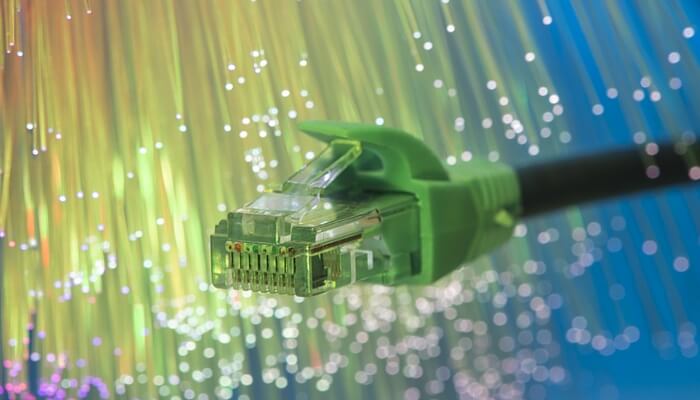
UFB Internet does not use landlines. UFB uses optical fiber cables with a smaller size and weight than normal telephone lines to provide the Internet. These optical fiber cables have special strands that are placed in a non-conductive housing. The aforementioned strings transmit optical signals instead of transmitting electricity signals, so categories such as interference in them through electric wires or damage caused by lightning strikes are not raised for optical fiber cables. To put it better, optical fiber cables show more resistance to being damaged by environmental factors.
Using optical fiber cables makes the provided connection one of the most high-quality and stable broadband connections offered around the world. Don’t forget that to use fiber internet, cables must be run separately to your house. Therefore, in general, the cost of setting up and using fiber internet is much higher. Fiber internet is more useful for businesses. Currently in Iran, fiber optic internet is provided only by the telecommunications company.
Fiber optic internet speed
Fiber optic internet is currently in the early stages of its development in Iran, and there is still a long time left until its wide distribution throughout the country. On the other hand, those who live in non-urban areas will definitely not get fiber optic internet anytime soon. However, if fiber optic internet is available in your city at any time, it is better to know that it will provide you with very high download and upload speeds. In fact, fiber optic internet is for those who transfer a large amount of data through the internet. Unlike DSL-based internet, you get the same quality regardless of where you are and how far you are from the center.
Source: Zomit