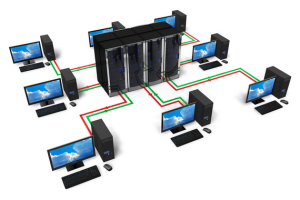
What is network topology?
Before setting up the network, you should pay attention to the network architecture. One of the most important elements in the design and architecture of a network is topology or so called network connectivity. Topology means the location and physical architecture of network components and how they are connected to each other.
Type of network topology
In this section, we will examine the types of network topologies.
Linear topology or BUS
In this topology, all systems are connected to a main cable or Trunk, this cable is also called Backbone. One of the advantages of this network is the low setup cost due to the lack of special equipment. One of the disadvantages of this topology is that if the trunk cable is cut, the entire network will be down.
Star topology
In this topology, all clients are connected to a central device, which is usually a switch or hub. This topology is one of the most common network topologies. One of the advantages of star connection is that if one of the devices is disconnected, there will be no problem for other systems. Also, managing and troubleshooting this type of network is easy, and one of the disadvantages of this topology is that if the central device has a problem, the entire network will be down.
Token ring topology
In ring networks, clients are connected to a device called MAU. This network has a ring structure, which means that every packet, wherever it wants to go, must first receive the token and then bypass each and every CLIENT to reach the desired destination.
Mesh topology
In this network, clients are directly connected to all other clients through several routes. This topology has high security and fault tolerance, but due to the need for more cables and ports for clients, it will naturally cost more.
Mesh topology itself is divided into two categories:
Full mesh: all systems are directly connected with other systems.
Partial mesh: Each system is only connected to a few systems, not all systems.
Hybrid topology
In this topology, several topologies are used in combination to have the best performance in the network in different conditions.
For example, in the image below, you can see the combination of Bus and Star topologies.
Wireless topology
This topology is specific to wireless networks that are widely used today. One of the disadvantages of this topology is its low security. In a wireless network, devices can communicate with each other in the following two ways:
ad hoc:
In this topology, devices set up a network with each other without any equipment and only through a wireless network card.
Infrastructure:
In this topology, network components communicate with each other through a device called Access Point. This type of topology is more stable and faster than ad hoc topology.