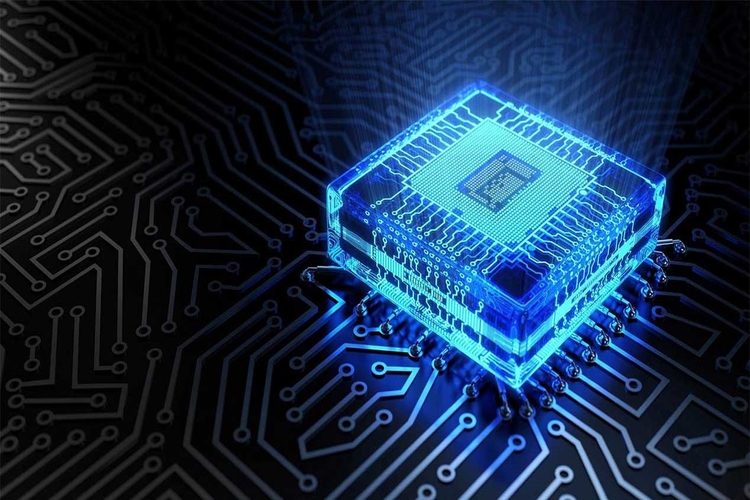
According to researchers, the new test of the world’s largest computer chip was successful. The chip can predict what will happen in the future “faster than the laws of physics can do.”
Cerberus’ CS-1 chip, which contains 1.2 trillion transistors, was 200 times faster than a supercomputer in simulating the amount of fuel in a power plant.
This chip, which is 462 square centimeters, was so powerful in analyzing and evaluating more than a million variables, from the ever-changing temperature to the three-dimensional movement of air particles, that it was able to show what is happening in reality faster than real time.
The design of this chip was done in collaboration with the US Department of Energy’s National Energy Technology Laboratory.CS-1 chip of Serbras company is described as “the most powerful artificial intelligence computing system in the world”. The number of transistors in this chip is 22 times more than the number of transistors in Nvidia’s 80GB E100 chip, which is designed for stunning supercomputers.
“This chip opens the door to enormous achievements in the world of scientific computing,” wrote Shukrat Serbras in his blog post. The CS-1 chip is the first system to demonstrate that it can simulate more than a million floating cells faster than real time. This means that when the CS-1 chip was used in a power plant fuel simulation, using information about operating conditions, it was able to show what will happen in the future faster than what happened with the laws of physics.”
A research about this achievement, which is still waiting to be reviewed by other experts in this field, was presented last week at the SC20 supercomputing meeting.
The enormous computing power of this chip can be used to train neural networks and run very sensitive simulations of the real world; Like simulating the best way to land a helicopter on an airport pad by simulating the movement of air particles around its blades.
The company also announced its next-generation chip, which is expected to have 2.6 trillion transistors, paving the way for even more complex real-world simulations.
This again raises questions about the computer simulations of the Matrix movie model, which speculate about the reality of life and the nature of existence.
The simulation hypothesis, developed in 2003 by the philosopher Nick Bostrom, states that in the future, the enormous power of computer computing will be used to create simulations that are indistinguishable from the real world.
This hypothesis has since been promoted and popularized by Elon Musk, the billionaire of the tech world. He claims that there is a 99.99% chance that the world we live in is also a computer simulation.
During a meeting in 2016, he said: “Forty years ago we only had the computer game Pong. Now, 40 years later, we have 3D simulation video games that look like the real world, played by millions of people at the same time, and every year it gets better and closer to reality. “If you accept any degree of progress, these video games will become indistinguishable from reality in the future, completely indistinguishable.”
Realistic simulations on the scale of the entire galaxy are still a long way off and probably not possible using traditional computers. However, the development of infinitely powerful quantum computers may pave the way for the creation of such worlds.
If this is possible, even on a limited scale, this technology will in theory be able to make accurate predictions about the future.
This theory, which was first proposed by Pierre Simon Laplace, a French scientist, as an intellectual hobby, and is called scientific determinism or cause and effect, states that using the laws of physics, if the exact location of each atom at any moment in time If we know about the galaxy, we can calculate the past and future events.
Known as Dave Laplace’s experiment, it was first described in 1814 and heralded an “intelligence” that could predict the future and reveal the past by calculating “all the situations that have ever existed and constitute nature.” make
In his philosophical essay on probabilities, Laplace wrote: “For such an intelligence, nothing is uncertain, and the future will be as present before its eyes as the past.”